
Casa de las Conchas: A Visitor's Guide to Salamanca's Shell House
The Casa de las Conchas is a late-Gothic urban palace at Calle Compañía, 2, in the heart of Salamanca's old town. Its stone facade carries around 350 carved scallop shells, the emblem of the Order of Santiago, and it has housed a public library since its conversion. Ten to twenty minutes covers the exterior; add a little more if the courtyard is open and you want to step inside.
Construction ran from 1493 to 1517 for Rodrigo Maldonado de Talavera, a chancellor of the Order of St James. That dating and the shell programme are the two facts worth carrying with you: they explain why a noble palace is dressed in pilgrimage symbols and why the windows vary so much from one another.
Why the Casa de las Conchas Is Worth a Stop
This is a building you read from the pavement. The reward is in the detail: hundreds of repeating shells, four Gothic windows that deliberately differ, a crest pulled at by lions, and a courtyard balustrade carved to look like basketwork. It is a short stop, not a museum visit, and it earns its place on a walk between the city's larger monuments, much like the other stops in our guide to the things to do in Salamanca.
Treat it as a ten-minute pause that gives you a feel for how Salamanca's noble families advertised themselves. If you are building a half-day route, pair it with the university buildings and the Plaza Mayor rather than giving it a slot of its own, and it fits naturally into a wider plan of the things to do in Salamanca.
Where It Is: Calle Compañía in the Old Town
The palace stands on Calle Compañía, a short lane in the pedestrian old town, close enough to the university quarter that you will pass it without a detour. Everything here is walked: park outside the historic centre or arrive by bus or train and continue on foot.
The old town around it is UNESCO World Heritage, which is the practical reason the streets are tight, stone-paved and best tackled in comfortable shoes. Pin the address before you set out, because the lane is narrow and the facade is easy to miss from the wrong angle.
The Facade: Around 350 Scallop Shells
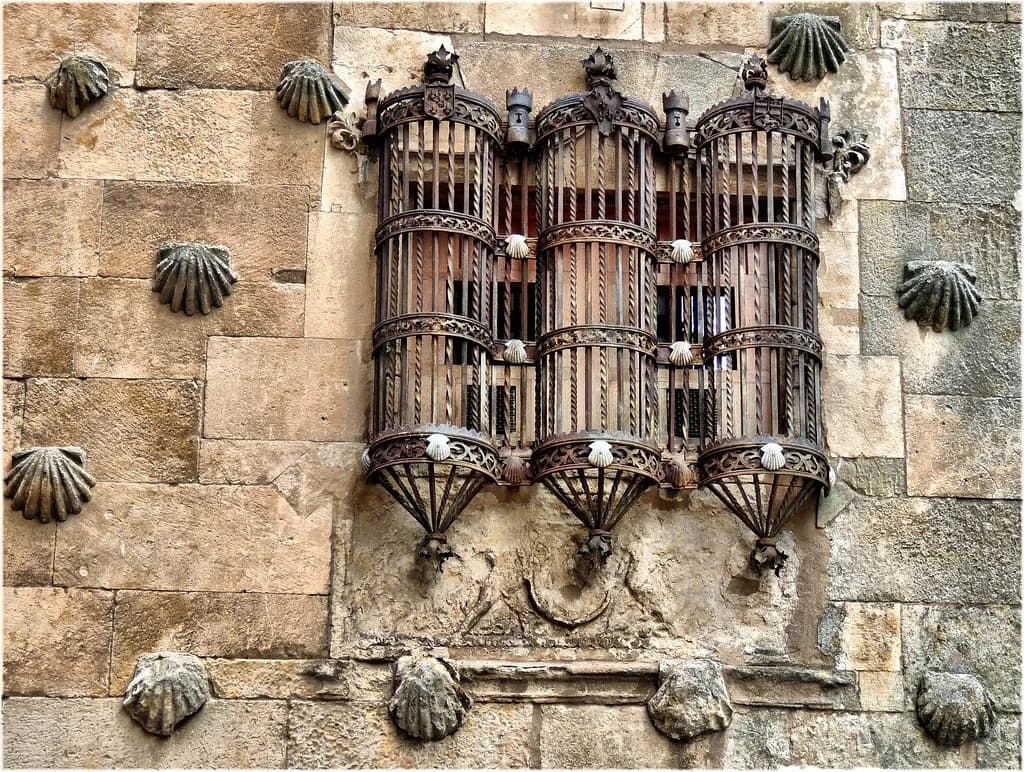
The shells are not decoration for its own sake. They are the symbol of the Order of Santiago, and the man who commissioned the house, Rodrigo Maldonado de Talavera, was a chancellor of the order. Once you know that, the facade reads as a statement of rank rather than a whimsical pattern.
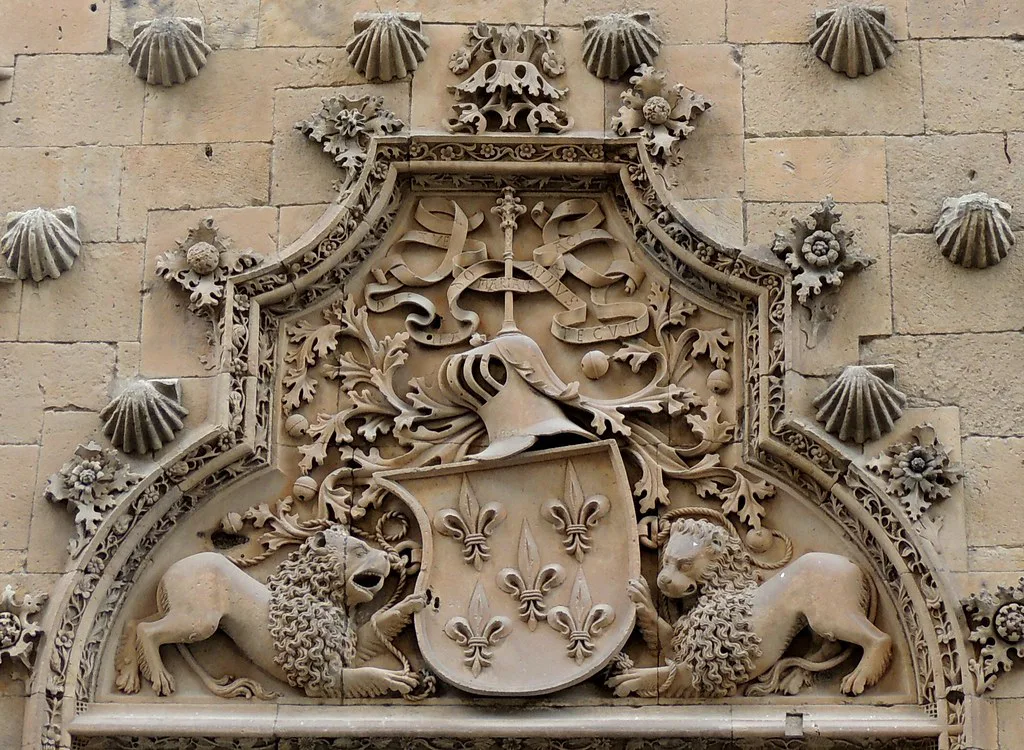
Look up as well as across. The four large Gothic windows are each different in design, an asymmetry typical of the style, and above the main door sits the Maldonado crest framed by curved mouldings. Over the lintel, dolphins are carved among plant motifs as a Renaissance symbol of love.
Over the entrance, lions grapple with the Talavera crest, one of the playful Plateresque touches that soften an otherwise severe stone front. The doorway itself is flat-topped with two decorative orders, and the whole composition is finished by a stately tower.
The Demolished Tower and the Maldonado Story
The tower you see is a stump of what was built. Carlos I ordered it reduced, costing the house two thirds of its height, as punishment for the Maldonado family after Francisco Maldonado was executed following the battle of Villalar and Pedro Maldonado was executed in 1522.
That truncated profile is the detail most short listings skip, and it is the one that makes the building political. A noble house was meant to tower over the city; this one was visibly cut down to size, and the squat roofline you photograph is the result.
The Courtyard: Basketwork Balustrade and Mixed Styles
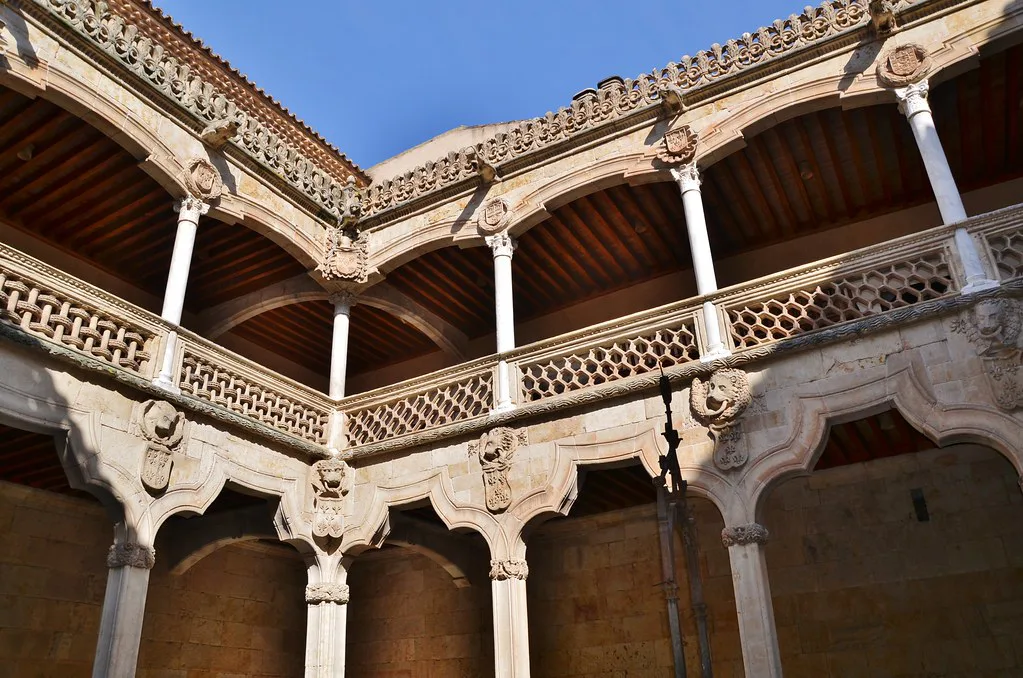
Step through the door if it is open and you reach an interior patio roughly 18.80 by 16.80 metres, where medieval, Mudéjar and Renaissance elements meet. The upper balustrade is carved to imitate basketwork, an intricately worked detail that rewards a slow look upwards.
This is a working library, so the courtyard is a passage and a pause rather than a sight to tour at length. Keep voices low, keep out of reading rooms, and take your photos quickly.
The Staircase and What the Carvings Mean
Inside, a three-section staircase leads to the upper floor, and it is deliberately not placed opposite the hall. The layout follows a Mediterranean tradition of protecting the household's privacy from curious visitors, so the ascent is shielded rather than grandly staged.
Each section carries its own heraldry. A dog supports the Pimentel shield at the first landing, a lion holds the Maldonado shield at the second, and the third shows the two families' arms joined, a marriage made in stone.
Inside Today: A Public Library
The palace now operates as a public library, so access follows the building's working life rather than a monument's timetable. Walk in quietly, look at the courtyard and staircase, and leave the desks to readers.
Check current opening times with the library or the Salamanca tourist office before making a special trip, since the facade alone is viewable from the street at any hour. No entry charge applies to viewing the exterior.
How Long to Allow and When to Go
Budget ten to twenty minutes. The facade takes five, the courtyard and staircase another five to ten if you can enter, and that is the visit. It slots neatly into a morning of old-town walking rather than forming an outing, and if you want to see how this stop fits alongside the city's other monuments, our guide to things to do in Salamanca maps out a full day.
Come early in the day or late in the afternoon for clearer light on the shell carvings and thinner crowds on Calle Compañía. Midday in high season brings groups through the same narrow lane, and the facade is harder to study when people are queuing for photographs.
What's Nearby in the Old Town
The University of Salamanca's historic buildings, including the Escuelas Mayores facade, are a few minutes away and make the natural next stop. Together with the Casa de las Conchas they give you the two sides of the city's self-image: learning and nobility.
The Plaza Mayor, one of Spain's great arcaded squares, is a short walk north and the obvious place to sit with a coffee afterwards. Its bars and terraces are also where you will eat if you are timing lunch to the Spanish afternoon. If you are weighing which square deserves your lingering, our guide to the things to do in Salamanca puts it in the context of a full day on foot.
For a longer loop, cross the river to the Puente Romano and look back at the old town skyline, which puts the palace and its cut-down tower in context. It is a twenty-minute walk each way and best done in dry weather.
If you are planning a wider day, our guide to things to do in Salamanca covers the rest of the monuments and how to string them together without doubling back.
Practical Points: Access and Hours
The building sits in a pedestrian zone with level paving to the door, but the historic interior has steps and a staircase, so access to the upper floor is limited. Visitors with mobility needs should ask at the entrance about which parts are reachable.
Opening hours and any access rules for the library change through the year and around public holidays. Confirm them with the library or the city's tourist information before you go, and remember the shell facade itself needs no ticket.
Plan Your Visit
The Casa de las Conchas is a fifteen-minute stop that pays off if you know what you are looking at: Santiago shells, four mismatched Gothic windows, a truncated tower and a library behind the door. Read the facade first, then step into the courtyard if it is open.
Build it into a walk that takes in the University of Salamanca and the Plaza Mayor, and you have a compact, walkable morning in the old town. Our Salamanca Attractions: 4 Visitor Guides collection covers the rest of the stops.
Frequently Asked Questions
What is the Casa de las Conchas?
A late-Gothic urban palace on Calle Compañía in Salamanca, built from 1493 to 1517 for Rodrigo Maldonado de Talavera, a chancellor of the Order of Santiago. Its facade is covered in around 350 carved scallop shells, and the building now houses a public library.
Why does the Casa de las Conchas have shells on it?
The scallop shell is the emblem of the Order of Santiago, to which the palace's commissioner belonged. The shells are a statement of rank and allegiance rather than decoration alone.
Can you go inside the Casa de las Conchas?
It operates as a public library, so you can usually pass through the courtyard and see the staircase at quiet moments. Keep voices low and stay out of reading areas. Confirm access with the library or the Salamanca tourist office before travelling.
How long do you need at the Casa de las Conchas?
Allow ten to twenty minutes. The facade is best studied from the street, and the courtyard and staircase add a little time if you can enter.
What else is near the Casa de las Conchas?
The University of Salamanca and its Escuelas Mayores facade, the Plaza Mayor, and, for a longer walk, the Puente Romano across the river. All sit within the old town and can be combined on foot.
Are opening hours and entry details published?
The building follows library hours rather than a monument timetable, and these change through the year. The library or the city tourist office can give you current times; check current details before planning around them.