
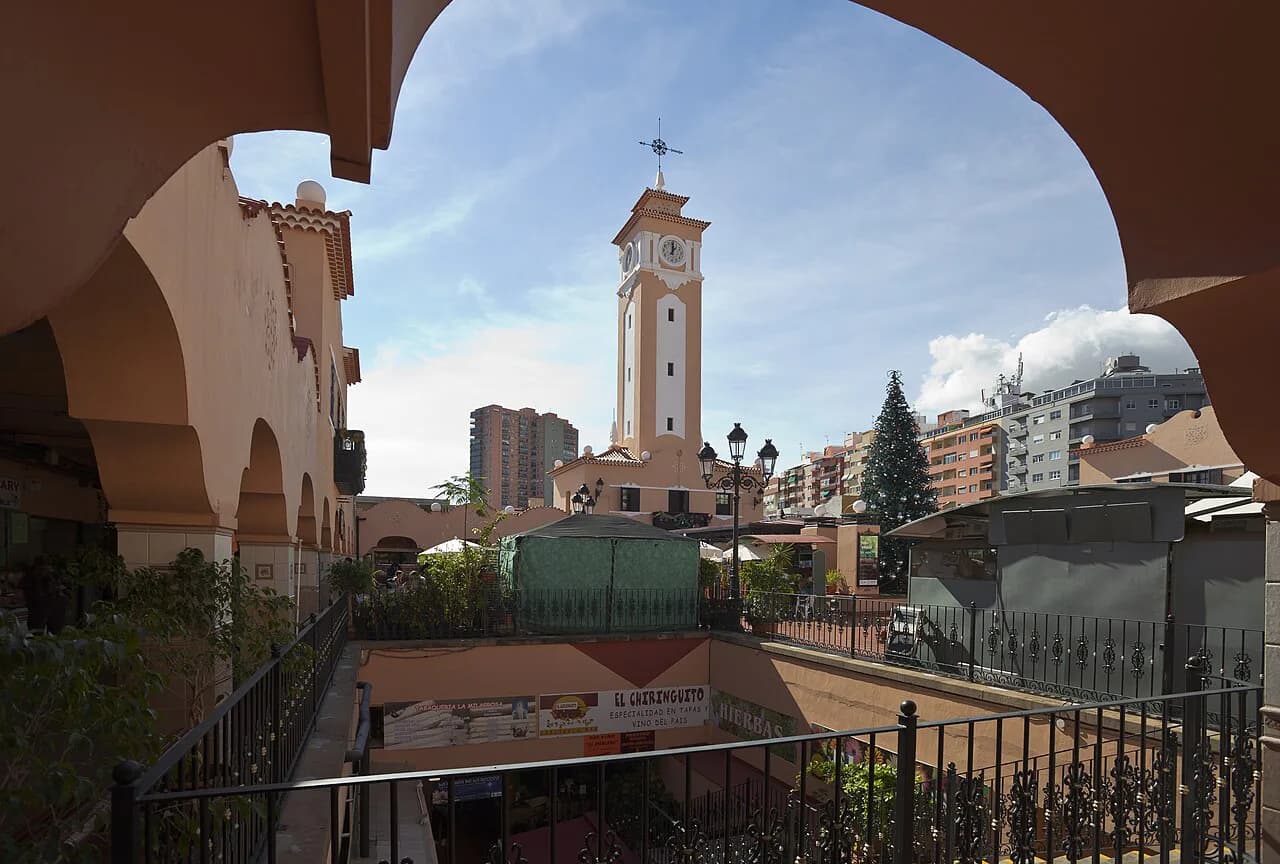
Mercado de Nuestra Señora de África: Santa Cruz's Market

The Mercado de Nuestra Señora de África is worth visiting for the building as much as the shopping: a 1942–43 structure by the architect Enrique Marrero Regalado with an eight-metre entrance arch, a neo-Canarian tower and three large patios linked by arcaded galleries. It is a working food market first, selling meat, fish, fruit, vegetables, cheeses, cured meats, bread and spices, with a gourmet tasting offer alongside.
It sits in the barrio de las Cuatro Torres in central Santa Cruz, close to the barranco de Santos and the Puente Serrador, which was built alongside the market and extended calle Valentín Sanz across the ravine. Building began in 1942 and the market was handed over to the Ayuntamiento in 1943, opening on 4 January 1944.
Where the market is
The market stands in the barrio de las Cuatro Torres, close to the antennae once used for wireless telegraphy, with the Puente Serrador carrying traffic over the barranco de Santos beside it. The building was declared a Bien de Interés Cultural as a monument in 2004, so the fabric of the place is protected as well as in daily use.
For orientation, treat the market as a central Santa Cruz landmark rather than an out-of-town excursion: it is within walking distance of the city's main shopping streets around calle Valentín Sanz. If you are planning a wider day in the city, our Tenerife Attractions: 6 Visitor Guides collection sets the market alongside the island's other major sights. If you are still deciding how long to base yourself here, our guide to how many days in tenerife weighs up a short city break against a longer island stay.
How to get there
Most visitors arrive on foot from the centre of Santa Cruz, following calle Valentín Sanz towards the barranco de Santos and the Puente Serrador. That approach brings you to the main façade, where the market's arcaded frontage opens onto the street.
If you are coming from further out, the tram and city bus network serve central Santa Cruz, and the market's position near the ravine puts it on a natural walking route between the shopping district and the streets south of the barranco. Fares and timetables change, so buy tickets at the machine or check the Titsa and Metrotenerife sites on the day.
The building: arch, tower and galleries
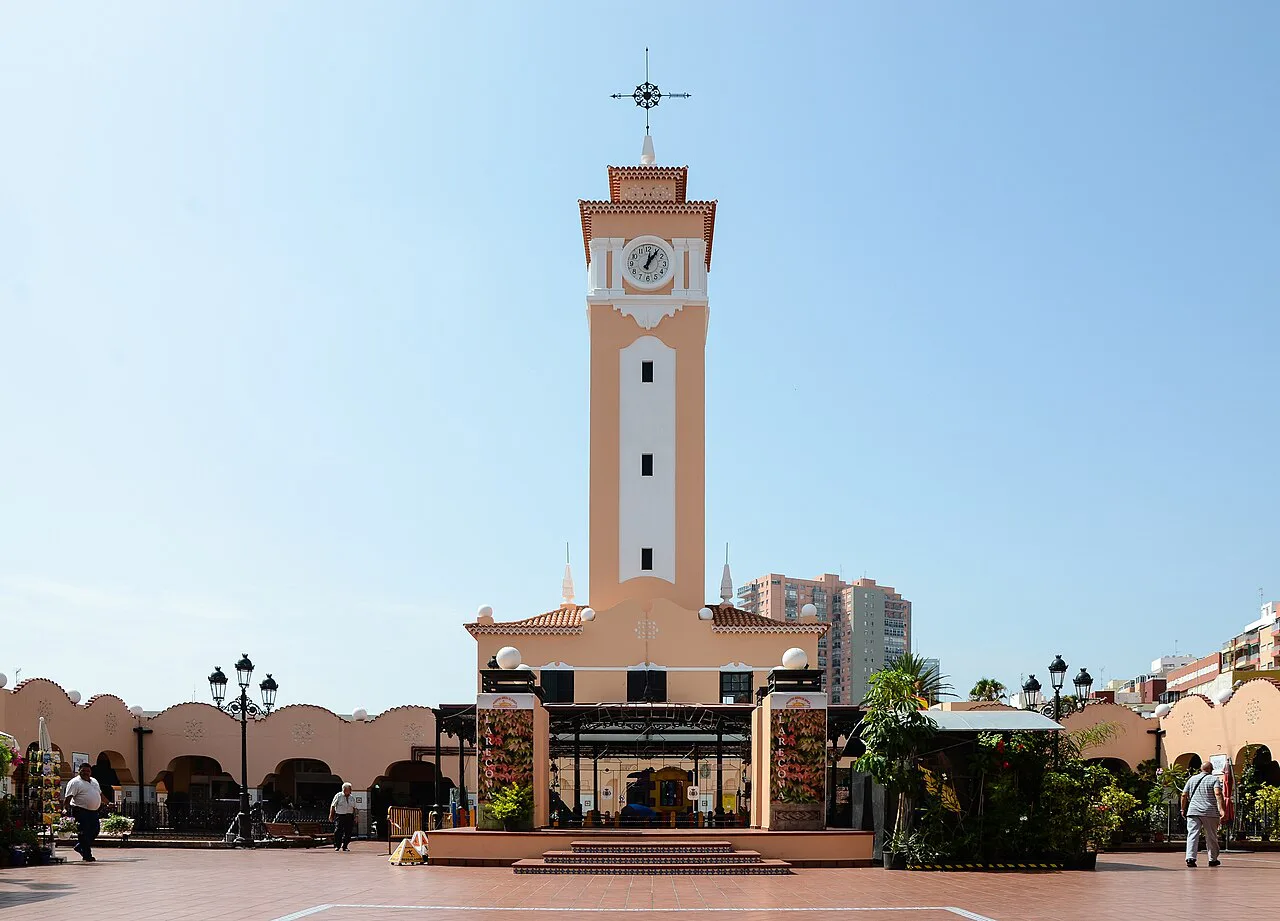
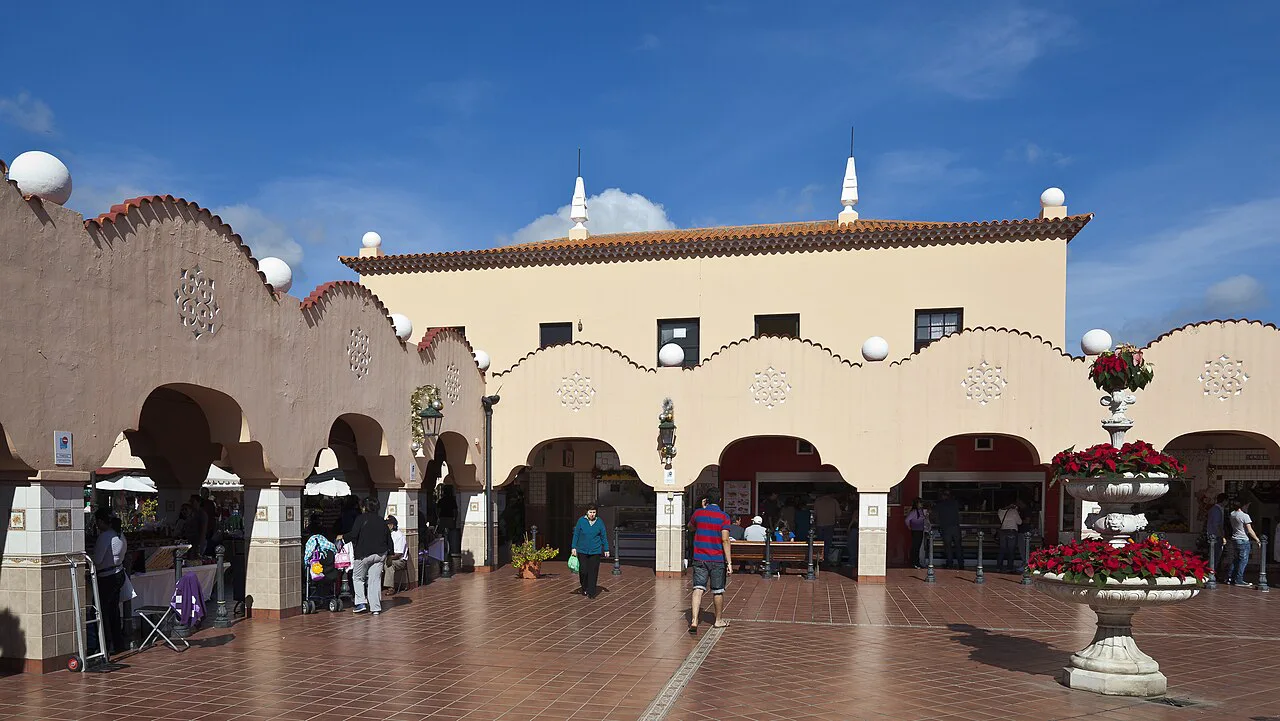
The architecture is the reason to come even if you are not shopping. The entrance arch has a radius of eight metres, and behind it the neo-Canarian tower rises above a layout that turns every space towards the Plaza Mayor. Three patios of generous size communicate through galleries supported on arcades, and the stalls are distributed along those galleries.
The project was drawn up by Enrique Marrero Regalado, with the municipal architect Enrique Rumeu de Armas directing the works and the company Entrecanales y Távora executing them. The money came from a 1,500,000-peseta contribution by the Mando Económico de Canarias in the 1940s, given on condition that a representative supervised and audited the construction.
Plaza Mayor and the three patios
Work out the plan before you start walking: the Plaza Mayor is the hinge, and the three large patios open off it through galleries resting on arcades. The selling positions for meat, fish, fruit, vegetables and general merchandise are arranged along those galleries rather than in one open hall, so a slow circuit of the patios shows you the whole market.
The market has been renovated since its inauguration on 4 January 1944, which was presided over by Captain General Francisco García Escámez e Iniesta and attended by the city's civil and military authorities, with the installations blessed by the bishop of the diocese, fray Albino González Reigada. The building keeps the proportions and circulation of the original design.
What the stalls sell
This is a food market rather than a food hall. The stalls cover fruit and vegetables, meat, fish, frozen goods, poultry, salted fish, preserves, charcuterie, bread, pastry, cheeses, dairy, pasta, fresh flowers and spices, so you can assemble a picnic or buy a serious piece of cheese or cured meat.
A cooperative has managed the market's businesses since 1 July 1995, handling both customer demands and the needs of the stallholders. Prices are set by individual stalls and are not posted anywhere central, so ask before you commit to a cut of fish or a wedge of cheese.

Eating at the market
Alongside the produce stalls the market runs an excellent gastronomic offer with gourmet tastings, which makes the building a place for a snack or a light meal as well as a shop. Exactly which counters are open, and on which days, changes through the year, so look at what is trading when you arrive rather than planning around a particular stall.
Time your visit around Spanish meal times: lunch runs from about 1.30pm to 4pm and dinner starts at 8.30pm or 9pm, which makes mid-morning to early afternoon the most natural window for a market visit with food. If eating here is the main point of the trip, come before the lunch service rather than after it.
Flower kiosks and the old tower clock
Several kiosks in the central patio sell seasonal flowers, giving the market entrance its most photographed image. Look for them first if you are short of time, since they sit on the main axis of the building.
Inside a methacrylate case you can see the machinery of the first clock installed in the tower, which ran from 1943 to 2004 and still works on the original weighted drive with an electric winder. It is easy to walk past, so look for the case before you leave the central patio.
The Rambla and its 32 stalls
Do not stop at the market doors. Along the Rambla attached to the building there are 32 stalls selling bazaar goods, household items, clothes, accessories, shoes, craftwork and books, which is where much of the non-food shopping happens. Treat this as a separate browse from the food patios and give it its own twenty minutes.
The stalls here were once rotating and temporary, with sellers from across the island setting up in the surrounding streets because there was no fixed place for them. The commercial capacity was expanded in 1960 by using the basement as a store and fitting cold rooms in the semi-basement.
The two entrance sculptures
Two sculptures at the market entrance carry local tradition: La Lechera, by Guzmán Compañ Zamorano, and the Homenaje al chicharrero, by the Tenerife-born Javier Murcia Trujillo. Chicharrero is the nickname for people from Santa Cruz, so the second piece is a portrait of the city as much as a decoration.
Both stand at the entrance to the market, so you pass them on the way in rather than hunting for them inside. Pause for a proper look on the way out, when the light on the entrance arch is behind you.
How long to allow
Budget thirty to forty-five minutes for a brisk circuit of the patios, the flower kiosks and the clock case, plus the Rambla stalls. A proper visit with a tasting, a cheese purchase and a slow lap of the produce galleries takes closer to two hours; if that timing shapes the rest of your trip, use our guide to how many days in tenerife to plan around it.
The market works well as a morning stop before a longer walk through the city, and the reviews left by other visitors describe it as a long-established permanent market with clothing and souvenirs on sale alongside the meat and vegetables.

Opening hours and market days
Opening hours, market days and any August or winter break are not fixed from year to year, so confirm current times with the Mercado de Nuestra Señora de África before you set out. Food markets tend to trade best in the morning, and arriving early gives the stalls time to be fully set up.
The market's own history page records the building's background and is the place to look for current opening information. Check it the week you travel rather than weeks ahead.
What's nearby
The Puente Serrador crosses the barranco de Santos right beside the market and is worth a look for its four lion effigies at the ends, placed there in memory of the action at the Alto de los Leones in the Sierra de Madrid. Continue along calle Valentín Sanz for the central shopping streets.
For a change of pace after the market's noise, Parque García Sanabria, Santa Cruz gives you a city park within the same central area, and the auditorio de tenerife sits on the waterfront for an evening concert or a look at the building. Both fit into a single day on foot.
If you are building a wider island itinerary, the Castillo de San Cristóbal, Santa Cruz de Tenerife is close to the Plaza de España in the old centre, and the Basílica de Nuestra Señora de la Candelaria makes a half-day trip south of the city. Our things to do in tenerife guide covers how these fit together.
Practical tips
Bring cash as well as a card, since small stalls vary in what they accept, and carry a bag for anything you buy. The patios are busy in the late morning, so go early if you want photographs of the arcades without people in them.
If the market is part of a longer island trip, our Teide National Park, Tenerife guide covers the high-mountain day that pairs naturally with a city morning in Santa Cruz. Keep the two on separate days: the mountain rewards an early start. If you are still weighing up the length of your stay, our guide to how many days in tenerife helps you decide how much time to give the city and the mountains.
Plan Your Visit
The Mercado de Nuestra Señora de África earns its place on a Santa Cruz itinerary on three counts: the 1940s Marrero Regalado building with its eight-metre arch and neo-Canarian tower, the working food stalls around the Plaza Mayor, and the Rambla's 32 outdoor stalls for clothes, household goods and crafts.
Come in the morning, allow an hour or two, and treat the market as the anchor of a walk through the barranco de Santos and calle Valentín Sanz rather than a quick shopping stop. Confirm the day's trading hours with the market before you travel, then leave the rest of the plan loose.
Frequently Asked Questions
What can you buy at the Mercado de Nuestra Señora de África?
The stalls sell fruit and vegetables, meat, fish, frozen goods, poultry, salted fish, preserves, charcuterie, bread, pastry, cheeses, dairy, pasta, fresh flowers and spices. Elsewhere in the building there is a gourmet tasting offer, and along the Rambla you will find bazaar goods, household items, clothes, shoes, craftwork and books.
Is the market worth visiting in Santa Cruz de Tenerife?
Yes, and not only for shopping. The building, with its eight-metre entrance arch, neo-Canarian tower and three arcaded patios around the Plaza Mayor, was declared a Bien de Interés Cultural as a monument in 2004, so the architecture alone justifies the detour.
How long does it take to visit the market?
Thirty to forty-five minutes covers the patios, the flower kiosks, the old tower clock and the Rambla stalls. Add time for a tasting, a cheese or charcuterie purchase and a slow lap of the produce galleries and you should allow closer to two hours.
What is the architecture of the Mercado de Nuestra Señora de África?
The project was drawn up by Enrique Marrero Regalado, with the municipal architect Enrique Rumeu de Armas directing the works from 1942. The entrance arch has a radius of eight metres, a neo-Canarian tower rises above the complex, and the Plaza Mayor connects three large patios through galleries resting on arcades.
Are there places to eat inside the market?
The market has a gastronomic offer with gourmet tastings, so it works as a snack stop as well as a food shop. Which counters are trading varies, so check when you arrive rather than planning around a particular stall, and aim for the lunch window from about 1.30pm.
When is the best time to go to the market?
Mornings are best for seeing the stalls fully set up and the patios before the late-morning crowds. If you want to eat there, come before the lunch service, which in Spain usually runs from about 1.30pm to 4pm.
What is there to see near the market?
The Puente Serrador crosses the barranco de Santos beside the market, with four lion effigies at its ends, and calle Valentín Sanz leads into the central shopping streets. Parque García Sanabria, the Auditorio de Tenerife and the Castillo de San Cristóbal are all within the same central area.
How do you get to the market?
Walk from central Santa Cruz along calle Valentín Sanz towards the barranco de Santos and the Puente Serrador, which brings you to the market's main façade. Trams and city buses serve the centre for anyone coming from further out, with fares and timetables changing by season.