
Arab Baths Girona (Banys Àrabs): What to See and How to Visit
The Arab Baths in Girona are a compact Romanesque public bathhouse in the Old Town, not a working spa. You walk through a short sequence of stone rooms, look down into a central plunge pool, and come out again within half an hour. Tickets, hours and the room layout are set out below.
The visit suits anyone already wandering the lanes around the cathedral, and it is short enough to slot into a morning. Set against that, the interior is genuinely small: anyone expecting a Hammam-style experience or a long museum should head elsewhere.
Where the Arab Baths are in Girona
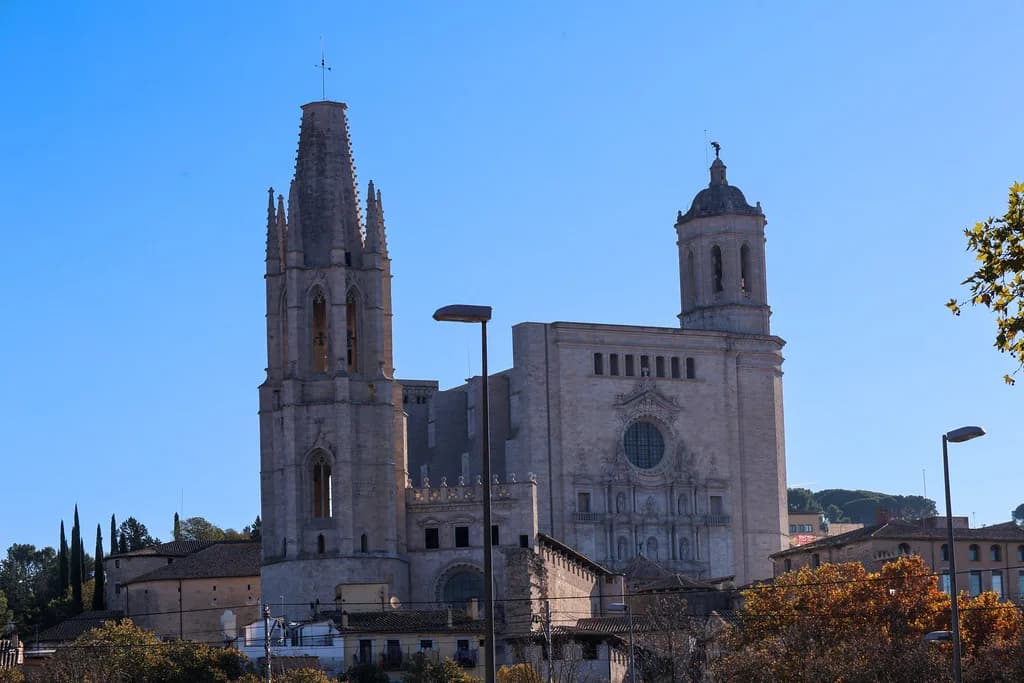
The baths stand at Carrer Ferran el Catòlic in the Old Town, between the Church of Sant Feliu and the city wall, with the cathedral rising above. That corner of Girona stacks several sights within a couple of minutes of each other, so the baths work best as one stop on a walk rather than a standalone trip.
Because the address sits inside the pedestrian old quarter, you arrive on foot. Come up from the river side through the lanes past Sant Feliu, or down from the cathedral steps, and the entrance appears in a narrow street rather than on an open square.
How to Get There and What to Expect on the Approach
There is no parking or drop-off at the door; the old town is walked. From the newer city across the river, the natural route crosses towards the cathedral quarter and climbs through streets that narrow as you go. Wear shoes that cope with cobbles and steps, because the approach is uneven.
The streets immediately around the baths are tight and often busy with groups moving between the cathedral and Sant Feliu. If you want the exterior photographs without crowds, arrive earlier in the day rather than mid-afternoon.
What the Building Is: A Romanesque Room Sequence
Despite the name, this is a Romanesque building rather than an Islamic-era bath. Its plan follows the classic public bath sequence, and the official site labels the rooms as the apodyterium, frigidarium, tepidarium, caldarium and furnace, so you can follow the same order as you walk through.
The apodyterium was the changing room, the frigidarium the cold room, the tepidarium the warm room and the caldarium the hot room, with the furnace supplying the heat. Knowing the names turns a quick look into a readable building: you are tracing how bathers moved from cold to hot and back again.
The official site describes the complex as the best preserved Romanesque public baths currently known. Treat that as the reason to slow down inside rather than rush the doorway.
What to Look at Inside
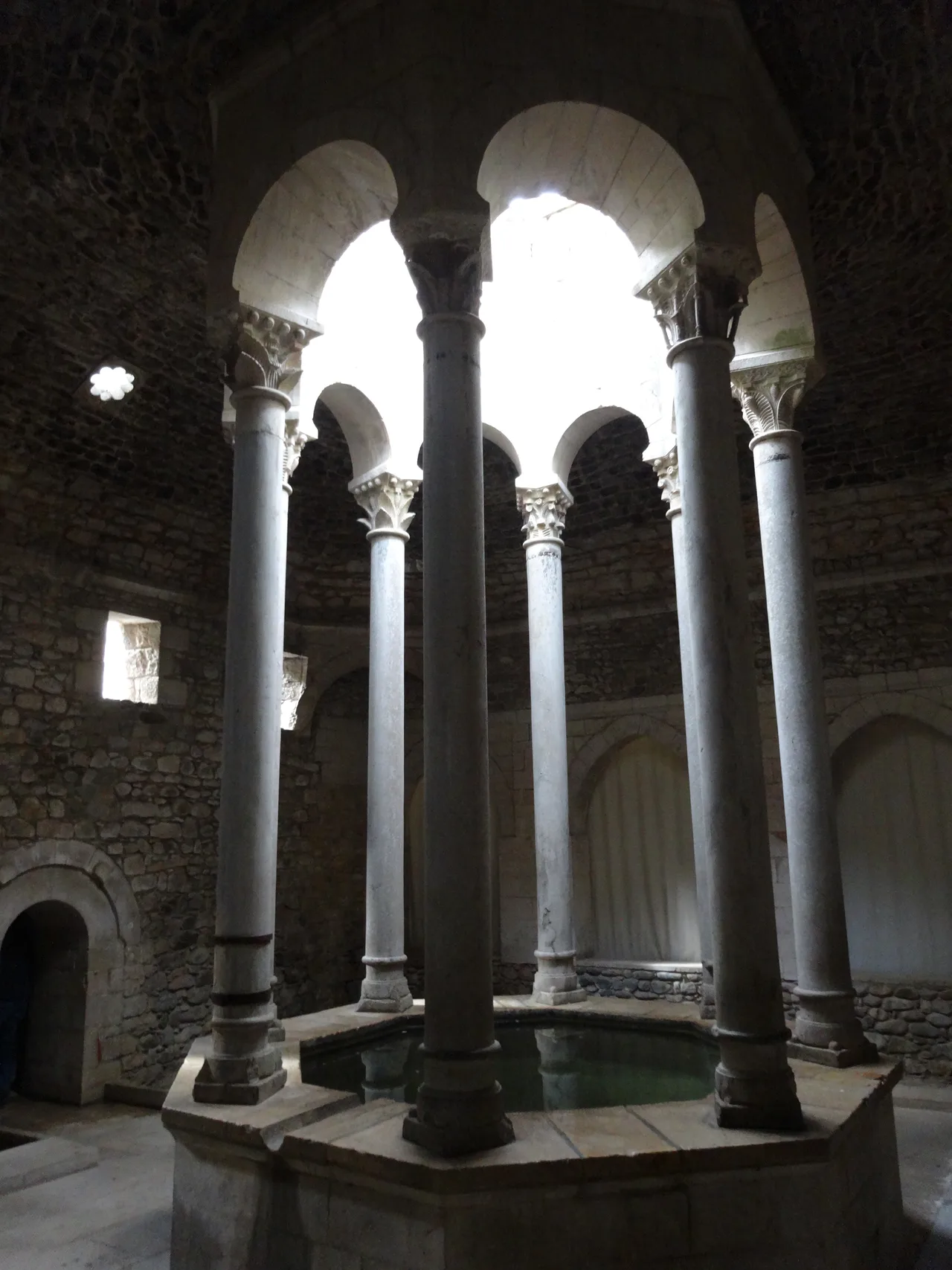
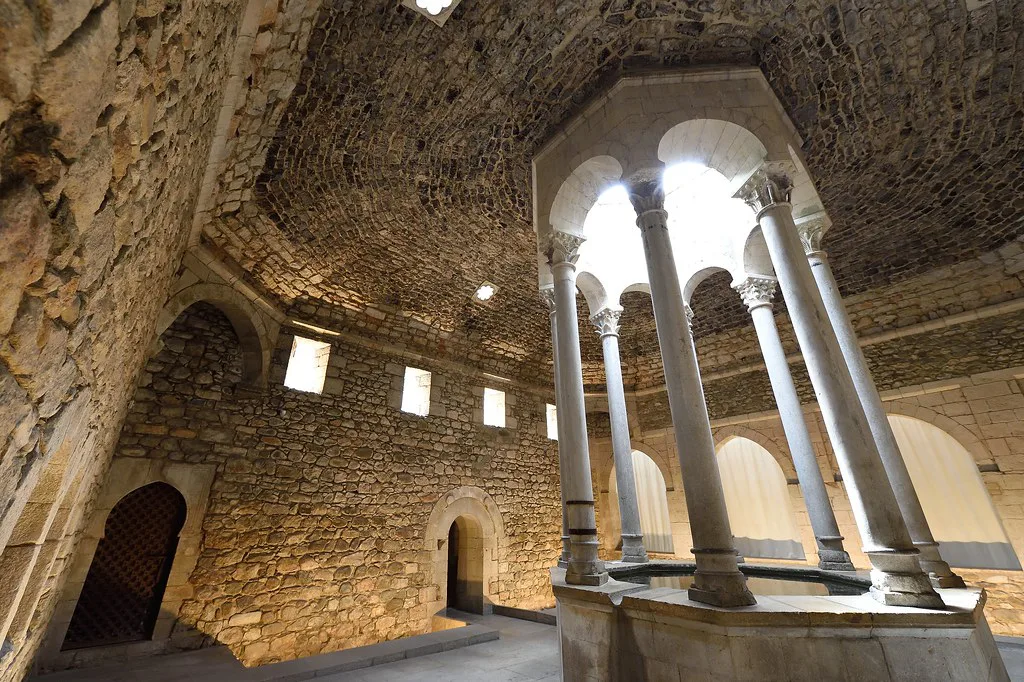
The centrepiece is the central plunge pool under a lantern roof, ringed by slim columns and arches that carry the weight above. Look up at the capitals and the light falling through the opening; this is the image most visitors carry away.
Beyond the pool, the side rooms hold the story of the building's reuse, and the stonework shows later alterations rather than a pristine ancient interior. Read the panels as you go: they explain what each space was for and why the structure survived when so many others did not.
This is a historic monument to tour, not a place to bathe. Photography of the architecture is the main activity, and the space is small enough that a handful of other visitors can fill it.
A Short History Worth Knowing Before You Go
Public baths in Girona are first mentioned in 1194. In 1285 the complex was partly destroyed during the siege by the troops of Philip III of France, and in 1294 King James II commissioned Ramon Taialà, a citizen of Girona, to rebuild it.
In 1342 the baths belonged to Arnau Sarriera, physician to Peter III, and during the Middle Ages some rooms appear to have been used temporarily as a mikveh by the city's Jewish community. In 1618 a community of Capuchin nuns bought them and folded the building into their convent.
Nineteenth-century travellers including Alexandre de Laborde publicised the baths through drawings and engravings, and later study by Josep Puig i Cadafalch supported their purchase by the Girona Provincial Council in 1929. After restoration they opened to the public in 1932.
Tickets and Opening Hours
Standard entrance is 3 euros per person, with a 2 euro ticket for visitors over 65 and a 1 euro reduced ticket for students, groups over 15 people, children under 16, unemployed visitors and large or single-parent families; under-8s go free. The baths publish these rates on their own site, and you should confirm them before travelling.
Opening hours run Monday to Saturday from 10am to 6pm, and Sundays and bank holidays from 10am to 2pm. The baths close on 1 and 6 January and on 24, 25 and 26 December, so a winter city break needs a little planning around those dates.
Book nothing in advance on the strength of a third-party listing. The baths' own page carries the current hours and prices, and it is the only version worth acting on.
How Long to Allow and When to Go
Give the baths 20 to 30 minutes inside. The rooms are few and close together, and the visit is contemplative rather than busy: you look, you read the panels, you photograph the pool, and you leave.
Pair it with the cathedral next door and you have a solid half-day in the old town without rushing. Add the city wall walk and the morning stretches comfortably.
For a quieter look at the pool, aim for the first hour after opening on a weekday, when tour groups are still working their way up from the river. Weekends and bank holiday mornings are shorter, closing at 2pm, so a late arrival can leave you outside.
Nearby: Sant Feliu, the Cathedral and the City Wall
The Church of Sant Feliu is effectively next door, and its bulk is part of the reason the baths feel tucked away. From the entrance, the cathedral steps are a short climb and the Plaça de la Catedral opens up above the old town.
The city walls run along the edge of the old town and give you the wide view back over the rooftops, including the cathedral tower. Walk them after the baths rather than before, since the climb is the more tiring part of the day.
For a different kind of stop in the same quarter, the Girona Art Museum sits in the Episcopal Palace near the cathedral, and the Cinema Museum is a short walk away across the old town.
Practical Tips: A Small Interior and No Bathing
The interior is small, so keep bags close and voices low; guided groups pass through in waves and the pool room can feel cramped when two arrive together. No bathing takes place here, whatever the name suggests.
Tripods and large camera bags are awkward in the narrow rooms, and the light through the lantern is the shot worth having. Check the site or the door for any photography restrictions on the day.
Allow time for the lanes as well as the building. The streets between Sant Feliu, the cathedral and the wall are part of the pleasure, and getting lost in them costs nothing.
Is It Worth It? Who Will Enjoy It
The Arab Baths suit travellers who like Romanesque stonework, small historic interiors and a short, cheap stop between bigger sights. At 3 euros for a standard ticket, the risk is low even if you only stay 20 minutes.
Skip it if you want a thermal spa experience, a long museum visit or somewhere to soak. Families with very young children will find the visit brief, and anyone short of time should prioritise the cathedral and the walls.
The honest trade-off is size against significance: this is an important survivor of Romanesque public bathing, packed into a few rooms. Go knowing that and it rewards a careful half-hour.
Aqva Gerunda: The Separate Modern Thermal Spa
Do not confuse the Banys Àrabs with Aqva Gerunda, a modern thermal spa on Carrer dels Galligants with a thermal circuit, massage and rituals on offer. It is a working wellness business where you book treatments, not a historic monument you walk through.
If you want to soak rather than sightsee, contact the spa directly for its rates, schedules and booking rules, which change by treatment and season.
Plan Your Visit
Treat the Arab Baths as a 30-minute stop in the old town, entered from Carrer Ferran el Catòlic between Sant Feliu and the wall. Check the official page for current prices and holiday closures before you set out, then build the cathedral and the walls around it.
For the rest of the city, from the river bridges to the museums and the long wall walk, start with the wider Girona guide and work out where the baths fit into your day.
Explore more Girona guides
Frequently Asked Questions
Where are the Arab Baths in Girona?
They are in the Old Town at Carrer Ferran el Catòlic, between the Church of Sant Feliu and the city wall, below the cathedral. You reach them on foot through the narrow lanes of the old quarter; there is no parking at the door.
What can you see inside the Arab Baths?
A short sequence of Romanesque rooms labelled the apodyterium, frigidarium, tepidarium, caldarium and furnace, built around a central plunge pool with slim columns and a lantern roof. The official site describes the complex as the best preserved Romanesque public baths currently known.
Do you need tickets for the Arab Baths in Girona?
Yes, entry is ticketed. Standard, over-65 and reduced rates apply, with free entry for children under 8. The baths' own site publishes the current rates, so check them there before you travel rather than relying on third-party listings.
What are the opening hours?
The baths publish Monday to Saturday opening from 10am to 6pm, and Sundays and bank holidays from 10am to 2pm, closing on 1 and 6 January and 24 to 26 December. Hours can change, so confirm on the official page before travelling.
How long do you need at the Arab Baths?
Allow 20 to 30 minutes inside. The rooms are few and close together, so the visit is short; pair it with the cathedral next door and the city wall walk to fill a morning.
Are the Arab Baths the same as Aqva Gerunda?
No. The Banys Àrabs is a historic monument you tour, with no bathing. Aqva Gerunda is a separate modern thermal spa on Carrer dels Galligants offering a thermal circuit, massage and rituals, and you book directly with it.
Are the Arab Baths Roman or Arab?
The building is Romanesque, despite the name. The room plan follows the classic public bath sequence and the official site presents the complex as the best preserved Romanesque public baths known.
What is near the Arab Baths?
The Church of Sant Feliu is next door, the cathedral steps are a short climb, and the city walls give the wide view over the rooftops. The Girona Art Museum in the Episcopal Palace and the Cinema Museum are both within a short walk.