
Aljafería Palace: a Visitor's Guide to Zaragoza's Islamic Palace
The Aljafería Palace is the one sight in Zaragoza that compresses the city's whole history into a single visit. It was built in the 11th century as an Islamic castle-palace, used both as a place of leisure and as a defensive building, and it still sits inside the remains of its fortified enclosure. It is also the working seat of the Parliament of Aragon, which makes it a more unusual visit than a museum reconstructions.
The trade-off is simple: the palace is a short walk from the old centre but not in it, so it works best as the first stop of a morning or the last of an afternoon. Allow enough time to slow down in the courtyard rather than treating the rooms as a checklist. This page covers the one building, its address and contact details, the architecture worth stopping for, and two nearby places within about a kilometre. If you are weighing it against the cathedrals and riverfront back in the centre, our guide to the things to do in Zaragoza helps you sequence both halves of the day.
What the Aljafería Palace is and why it matters
The Aljafería is an Islamic castle-palace dating from the 11th century, built in the Taifa of Zaragoza during the period of Al-Andalus. It was conceived as a leisure residence, but it also worked as a defensive structure, and the remains of its fortified enclosure survive around the palace today. That double purpose explains the shape of the place: a palace you can enjoy, wrapped in walls you cannot ignore.
Over the centuries it has been a fortified enclosure, an Aragonese royal residence, the headquarters and prison of the Inquisition, and a palace of the Catholic Monarchs. That layering, rather than a single period, is what makes the building worth an hour of your time rather than a quick photo stop.
It is now the seat of the Parliament of Aragon, so you are walking through a working institution as well as a historic building. Expect some parts of the complex to feel administrative rather than ornate, and check the palace's own visitor information before you set out for anything time-sensitive.
Where it is and how to get there
The address is Calle de los Diputados s/n, 50004 Zaragoza, and the published contact number is +34 976 289 683. The palace stands outside the tight old centre, a manageable walk from the core of the city rather than a taxi ride on the edge of town, which is why it slots easily into a day built around the centre.
On foot, the most useful approach is from the old centre towards Calle de los Diputados, keeping the palace's rounded towers in view as a landmark. If you are coming from further out, Zaragoza's tram and city bus network cover the central area, and the stop names on the Zaragoza tourism office maps are the reliable way to plan the last stretch.
Orient yourself on arrival by finding the Torreón del Trovador first: the tall rectangular tower is the easiest part of the building to pick out from the street. Once you have it, ticket entrance and the main route through the rooms are straightforward to find.
What you see inside: the layout and the towers
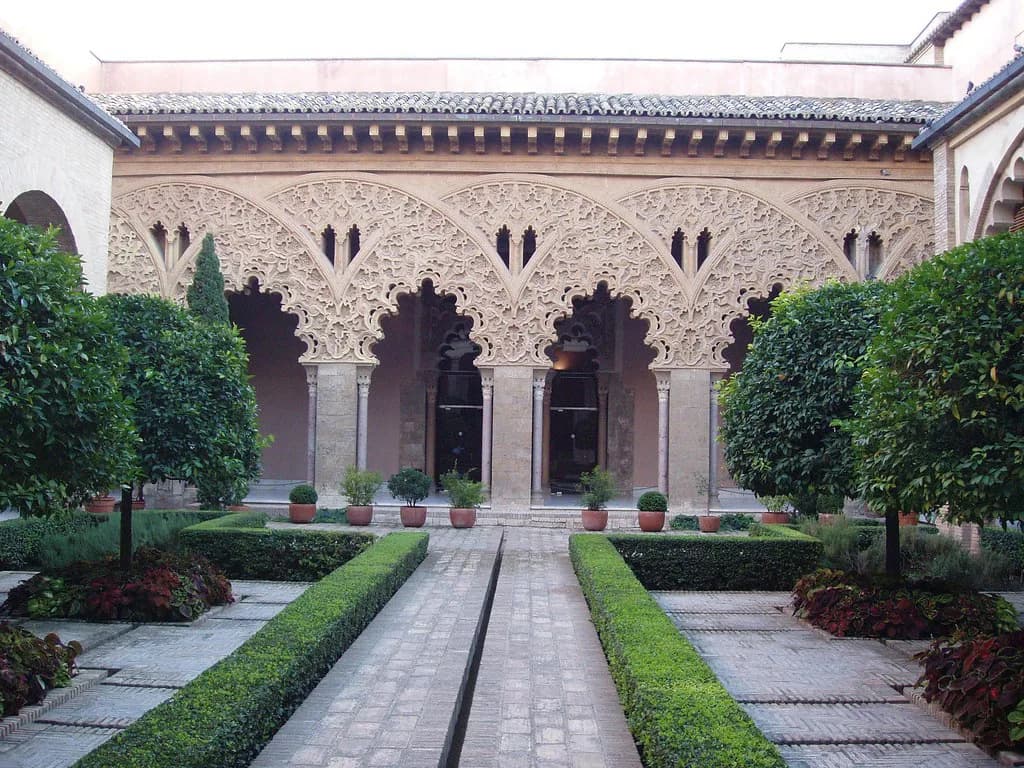
The palace has a quadrangular layout with rounded fortified towers at its corners, with the exception of the Torreón del Trovador, which has a rectangular plan. That one irregular tower is the visual oddity of the complex and the reason the skyline looks slightly lopsided. The rooms themselves are arranged around the courtyard, which opens to the sky in the centre of the building.
Walk in expecting a strong contrast between plain defensive outer walls and the refined interior that sits behind them. That shift is the point of the building: the outer shell talks about safety, the inside talks about pleasure.
The courtyard, ceilings and plasterwork
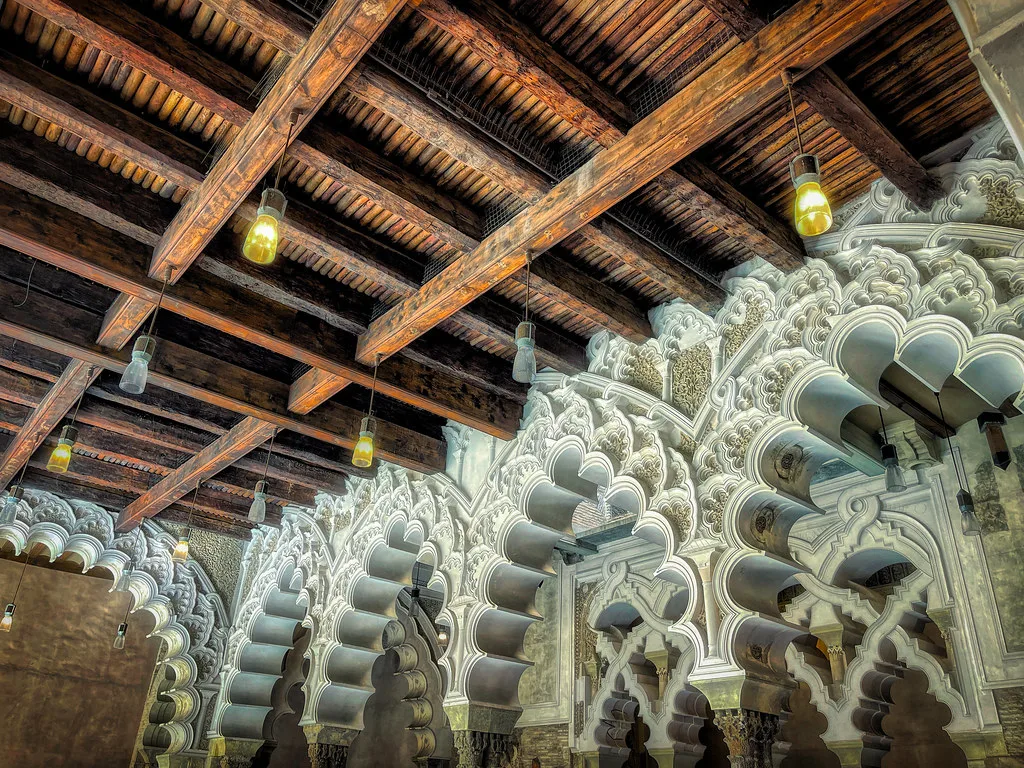
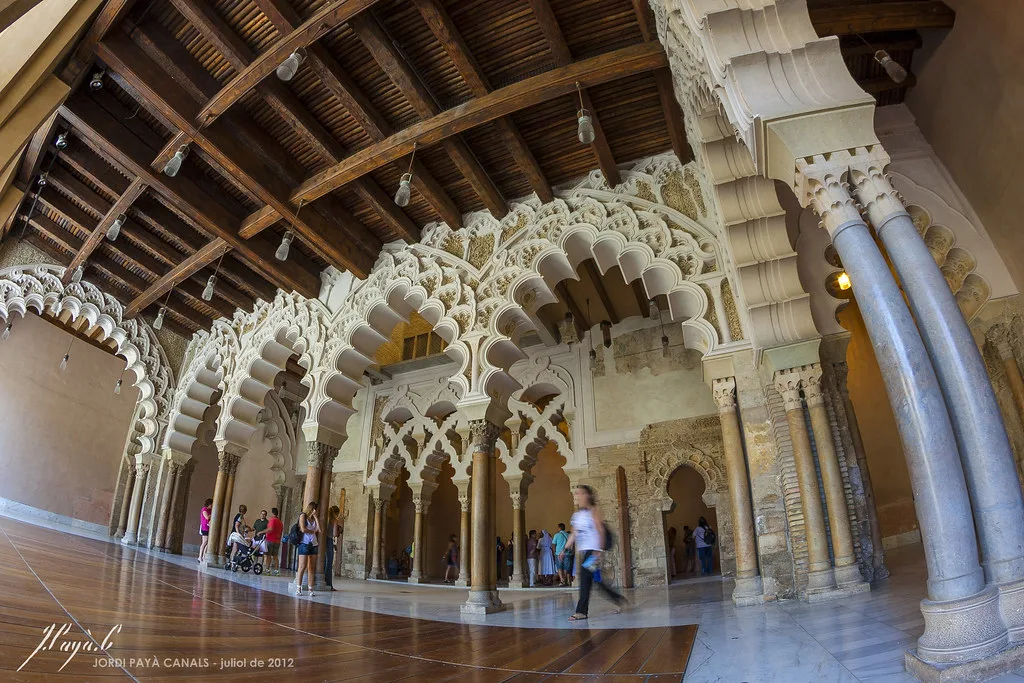
The courtyard open to the sky is the heart of the visit and the place to spend the most time, because the light in it changes what you see on the surrounding walls. The roofs, coffered ceilings and plasterwork decoration are among the palace's greatest charms, and they are easy to miss if you look only at floor level.
Look up in each room, not just in the famous ones: the carved plasterwork around arches and doorways rewards close reading as much as the larger ceilings do. A slow circuit around the courtyard, glancing back at the arcades from each side, is the most efficient way to see the ornament from different angles.
The palace's later lives
Aragonese royal residence, Inquisition headquarters and prison, and now the Parliament of Aragon: the same rooms have been reused repeatedly rather than preserved as a single-period monument. That is why the visit reads as a sequence of layers rather than a single era, and why the architecture shifts as you move from one part of the palace to the next.
The building's medieval fabric as a fortress palace built in the second half of the 11th century sits underneath all of those later identities. Keeping that timeline in mind makes the later additions and changes easier to read as you go round.
Tickets and booking
Tickets are sold through the palace's own online reservation page, linked from its official visitor information. Booking direct is the sensible route, because you are buying from the institution that runs the building rather than from a reseller. Entry prices and any concession rates are published there and on the palace's website, so check the figure before you finalise your day.
If you are visiting on a public holiday or in high season, reserve ahead rather than turning up and hoping, and confirm opening hours on the palace's website in the same check. Contact details, including the telephone number and email addresses, are published with the official listing if you need to ask about access.
The Goya exhibition at the palace
The palace hosts an exhibition titled Goya. From the Museum to the Palace, listed by Spain's official tourism website as running from 5 December 2024 to 31 December 2026. If Goya is part of why you are in Zaragoza, this is a reason to check the Aljafería's own exhibition details before you travel, since individual rooms may not all be given over to it.
For more Goya in the city itself, the Museo Goya. Fundación Ibercaja - Museo Camón Aznar in the old centre is a separate collection dedicated to the painter and his context. Pairing the two gives you the palace's own exhibition and the city's dedicated Goya museum in the same trip.
How long to allow and how to pace the visit
Budget around an hour and a half for the palace if you want to read the interpretation and sit in the courtyard, and a little less if you move briskly through the later rooms. The visit is indoor and largely self-guided, so the time you spend depends mainly on how long you stand still in the spaces that reward it.
A practical pace is to start with the outer walls and the Torreón del Trovador, then the courtyard, then the main rooms in sequence, finishing in the decorative interiors where the ceilings and plasterwork are strongest. Taking that route means the most elaborate spaces come last, and the contrast works in your favour.
Practical notes for UK, US and Irish visitors
Zaragoza runs on Spanish meal times: lunch is typically between about 1.30pm and 4pm, and dinner starts from about 8.30pm to 9pm. A late-morning palace visit finishes comfortably before lunch, while an afternoon visit works well before an early-evening drink and a late dinner in the centre.
Before you travel, confirm the palace's opening days, last entry and any seasonal changes on its own website, and read the booking page for conditions on changes or cancellations. Both are published by the institution that runs the building, which is the only place to rely on for anything that changes with the calendar.
Nearby: the Church of San Pablo and its Mudéjar brickwork
The Church of San Pablo in Zaragoza sits about 0.9 km away, and it is the most valuable testament of the Mudéjar style in the city. The brick tower and the decorative treatment of the exterior are the reason to add it to the walk back into the centre. Allow twenty minutes or so to look at it from the street, and more if you plan to go inside.
Mudéjar work also turns up across the old centre, so the San Pablo stop is a useful way to tune your eye for brick and tile before you reach the larger churches, including the Basílica de Nuestra Señora del Pilar covered among the things to do in Zaragoza.
Nearby: the IAACC Pablo Serrano
The Aragonese Institute of Contemporary Art and Culture, IAACC Pablo Serrano, is also roughly 0.9 km away, and it is the natural counterweight to the palace's Islamic and Mudéjar architecture. The museum is built around helping visitors understand contemporary art, so it gives you a modern bookend to a day that begins in the 11th century.
With both stops within about a kilometre, you can walk from the palace to San Pablo and on to the IAACC without needing transport between them. That makes a half-day of architecture and art feasible, with the old centre as your finish.
Pairing the palace with lunch or evening tapas
The palace fits neatly into a Zaragoza day built around food: visit mid-morning, then walk back into the centre for lunch around 1.30pm to 4pm, or visit in the late afternoon and head for the tapas bars before dinner from about 8.30pm to 9pm. The Mercado Central de Zaragoza in the centre is a natural stop for picking up provisions or eating between the two.
If you are building the rest of the day around the old centre, the Basílica del Pilar and La Seo sit close together, and Puente de Piedra gives you the classic view back across the Ebro. Use the palace as your morning anchor and the riverside basilica as the afternoon one. For the full picture of what else is worth your time, see our guide to the things to do in Zaragoza.
Plan Your Visit
The Aljafería Palace is the one place in Zaragoza where an Islamic palace, a royal residence and a working parliament share a single address on Calle de los Diputados. Go for the courtyard open to the sky, the coffered ceilings and the plasterwork, and give yourself time to notice how the defensive outside and the ornate inside pull against each other.
Book through the palace's own reservation page, confirm opening hours and exhibition details on its website before you travel, and build the rest of the day around Spanish meal times. San Pablo and the IAACC Pablo Serrano are both roughly 0.9 km away, which makes the walk back into the centre part of the visit rather than a commute.
Frequently Asked Questions
What is the history of the Aljafería Palace?
It is an Islamic castle-palace built in the 11th century in the Taifa of Zaragoza, used as both a leisure residence and a defensive building. Later it served as an Aragonese royal residence, the headquarters and prison of the Inquisition, a palace of the Catholic Monarchs, and it is now the seat of the Parliament of Aragon.
Is the Aljafería Palace worth visiting in Zaragoza?
Yes, if you want one building that shows the city's Islamic, royal and institutional history in sequence. The courtyard open to the sky, the coffered ceilings and the plasterwork are the highlights, and the Torreón del Trovador is the architectural oddity to look for from the street.
How long does it take to visit the Aljafería Palace?
Allow around an hour and a half to read the interpretation and spend time in the courtyard, less if you move quickly through the later rooms. Start with the outer walls and the Torreón del Trovador, then the courtyard, then the main rooms, so the most decorated interiors come last.
Where is the Aljafería Palace and how do I get there?
The palace is at Calle de los Diputados s/n, 50004 Zaragoza, and the published phone number is +34 976 289 683. It is a short walk from the old centre, and the tram and city bus network cover the central area if you are coming from further out.
What can I see inside the Aljafería Palace?
Inside are a quadrangular layout with rounded corner towers, the rectangular Torreón del Trovador, rooms arranged around a courtyard open to the sky, and roofs, coffered ceilings and plasterwork decoration. The palace also hosts a Goya exhibition, Goya. From the Museum to the Palace, listed as running from 5 December 2024 to 31 December 2026.
What is there to see near the Aljafería Palace?
The Church of San Pablo, about 0.9 km away, is the strongest example of Mudéjar brickwork in Zaragoza. The IAACC Pablo Serrano contemporary art museum is also roughly 0.9 km away, giving you a modern counterpoint to the palace's Islamic and Mudéjar architecture.
Do I need to book Aljafería Palace tickets in advance?
Tickets are sold through the palace's own online reservation page, linked from its official visitor information. Booking direct means buying from the institution that runs the building, and the booking page is where entry prices and conditions are published.
How do I fit the palace around Spanish meal times?
Lunch in Zaragoza is typically between about 1.30pm and 4pm, and dinner starts from about 8.30pm to 9pm. A mid-morning visit finishes before lunch, and a late-afternoon visit leaves time for a drink before a late dinner in the centre.